Let me be honest with you.
When I first started freelancing, I signed up for everything. Fiverr, Upwork, Freelancer.com, Toptal — I spread myself thin across five platforms at the same time and got exactly zero results for three weeks straight. It wasn’t because I wasn’t talented. It was because I had no idea which platform actually matched where I was as a beginner, what skills I had, and who I was trying to reach.
I wasted months figuring out something I wish someone had just told me plainly.
That’s exactly why I’m writing this article.
If you’re sitting there right now, wondering where to start your freelancing journey, feeling the mix of excitement and absolute overwhelm — I see you. And this guide is for you. In 2026, freelancing has genuinely changed. The rise of AI, the shift toward remote work platforms, the explosion of digital services — all of it has reshuffled the deck. Some platforms that were gold in 2021 are overcrowded now. Some newer ones are quietly making beginners rich.
The best freelancing platforms for beginners in 2026 are not the same list your cousin used three years ago. So let’s do this properly.
We’ll break down what actually works, what to avoid, why your platform choice matters more than your skill level when you’re starting out, and — critically — why the smartest freelancers aren’t relying on platforms alone anymore.
Stick with me. This is going to be worth your time.
Why 2026 Is Actually a Great Year to Start Freelancing (If You’re Smart About It)
Here’s something most people get wrong. They look at the freelancing space in 2026 and see competition. What they should be seeing is opportunity.
Yes, more people are freelancing than ever before. But here’s the other side of that coin: more businesses are hiring freelancers than ever before too. Companies that once insisted on full-time hires have spent the last few years building remote-first cultures. They’ve tasted the flexibility of hiring contract talent, and they love it.
According to trend data from multiple workforce reports, the global freelance market continues to grow at a remarkable pace — and that growth isn’t slowing down.
So the real question isn’t “is freelancing still viable?” The real question is: where do you show up, and how do you show up smart?
In our experience running KTHope.com and working with dozens of freelancers across different niches, we’ve noticed one thing consistently. Beginners who pick the right platform for their specific skill set — and then focus there instead of spreading thin — get their first client faster, build confidence quicker, and scale better.
That said, let’s actually dig into the platforms.
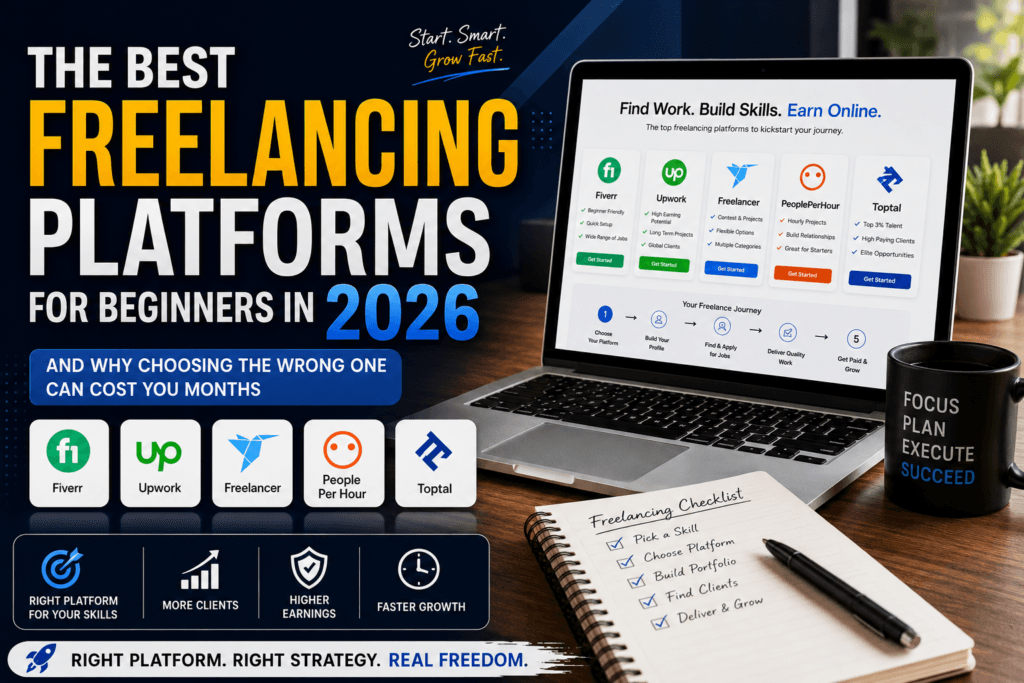
The Best Freelancing Platforms for Beginners in 2026 — Broken Down Honestly
1. Fiverr — Still the Most Beginner-Friendly Starting Point
If you’ve never freelanced before in your life, Fiverr is probably where you should start. I know some experienced freelancers roll their eyes at Fiverr. Ignore them. For a beginner, it has one advantage that no other platform matches: you don’t need to pitch anyone.
You create a gig (basically a service listing), you optimize it with the right keywords, and buyers come to you. That’s a massive psychological and practical advantage when you don’t have a client list or a portfolio.
The challenge with Fiverr? Standing out in 2026 takes more effort than it did in 2019. The platform is more competitive, and buyers are more sophisticated. You need a strong profile photo, a gig description that speaks directly to the buyer’s pain, and — honestly — some early reviews to build social proof.
What works well on Fiverr in 2026:
- Graphic design and branding
- Video editing and short-form content creation
- Voiceover and audio services
- AI prompt engineering (yes, this is a real category now)
- Translation and localization
- SEO content writing
What’s harder on Fiverr:
- High-ticket consulting
- Long-form development projects
- Building a long-term client relationship
Many beginners make this mistake on Fiverr: they set their prices too low, burn out fast, and then blame the platform. Don’t undercharge just to get reviews. Set fair rates, deliver extraordinary value, and the reviews will come.
2. Upwork — Higher Earning Potential, Steeper Learning Curve
Upwork is where the bigger money tends to live. That’s not a myth. We’ve seen freelancers on our platform discussions regularly land $50–$200/hour projects on Upwork once they understand how to use it.
But here’s the truth that nobody tells beginners: Upwork is brutal when you’re starting from zero. You need “Connects” (Upwork’s proposal credits) to apply for jobs. Your profile gets buried if it has no history. And you’re competing against established freelancers with years of reviews.
So should a beginner bother with Upwork?
Yes — but with a strategy.
The smart beginner approach to Upwork:
First, spend time making your profile genuinely excellent. Not just “filled out” — excellent. A professional headshot, a title that speaks to your niche, a summary that sounds like a human wrote it (not a template), and portfolio samples even if they’re personal projects or spec work.
Second, don’t apply to everything. Target smaller, newer job posts where the competition is thinner. A job posted in the last hour with two proposals is better than a week-old post with forty.
Third, write proposals like you actually read the job description. Most proposals on Upwork are copy-paste disasters. The moment yours sounds specific and human, you’re already in the top 10%.
Upwork is one of the best remote work platforms for freelancers who are willing to invest a few weeks into breaking in. After that initial hump, it pays off beautifully.
3. Toptal — Not for Beginners, But Know It Exists
Toptal is the selective, elite end of the freelance spectrum. They claim to accept only the top 3% of applicants, and their vetting process is genuinely rigorous.
We’re mentioning it here not because you should apply today (unless you’re already an experienced senior developer or designer), but because you should know where the ceiling is. Toptal is where you might aim in two or three years. Knowing it exists keeps you motivated and gives you a goal worth working toward.
4. PeoplePerHour — The Underrated European Alternative
Most beginners in Southeast Asia and South Asia overlook PeoplePerHour because it’s less globally recognized. That’s actually their advantage.
PeoplePerHour has a strong buyer base in the UK and Europe, and competition there is noticeably thinner than on Fiverr or Upwork. If you’re targeting European clients — especially for content writing, design, or digital marketing — this platform deserves a serious look.
The interface is clean, the project sizes are often mid-range (not too small, not overwhelming), and the community feels more professional than the bottom end of Fiverr.
5. LinkedIn Freelance Marketplace — The Trust-Builder
LinkedIn doesn’t get enough credit as a place to find freelance work online. The LinkedIn Services Marketplace lets you list your services directly on your profile. But more importantly, LinkedIn as a whole is one of the best places to attract inbound freelance clients in 2026 — especially if you’re in consulting, writing, marketing, or development.
Here’s what we personally noticed: clients who find you through LinkedIn tend to trust you more before the first conversation even happens. They’ve seen your profile, your posts, your recommendations. The relationship starts warmer.
If you’re serious about making money freelancing sustainably, don’t ignore LinkedIn even if you’re not using their marketplace specifically. Build your presence there consistently.
6. Contra — The New Kid Worth Watching
Contra is a newer platform that positions itself differently: it charges zero commission. Freelancers keep 100% of what they earn. That alone makes it worth trying.
It’s growing fastest among designers, developers, and creative professionals. The interface is beautiful and modern. The community skews toward higher-quality projects than the bottom tier of Fiverr.
It’s not yet as large as Upwork or Fiverr in terms of raw buyer volume, but the trajectory is impressive. Getting established there now, while it’s still growing, is a smart move for beginners who want to grow with a platform rather than fight for visibility on a saturated one.
7. Freelancer.com — Decent for Some Niches, Noisy for Others
Freelancer.com is one of the original online freelance marketplaces, and it still has a large user base. The challenge is that it can feel chaotic — especially with the contest-style projects and the sheer volume of low-budget posts.
That said, it has specific categories where serious buyers do show up: engineering projects, software development, and technical writing. If your skills fall into those areas, it’s worth having a profile there as a secondary platform.
For most beginners though, we’d suggest getting traction on Fiverr or Upwork first before adding Freelancer.com to the mix.
How to Actually Choose the Right Platform for Your Skill Set
This is where most beginner guides fail you. They give you a list of platforms. They don’t help you figure out which one is right for you specifically.
Here’s a simple framework we use when guiding new freelancers on KTHope.com:
Ask yourself three questions:
- What is my skill level honestly?
- Just starting: Fiverr, Contra, PeoplePerHour
- Some experience and portfolio: Upwork, LinkedIn
- Advanced, senior level: Toptal, direct outreach
- Who is my ideal client geographically?
- Global/US-heavy: Fiverr, Upwork
- UK/Europe-heavy: PeoplePerHour
- Business professionals: LinkedIn
- Do I prefer inbound (clients come to me) or outbound (I pitch clients)?
- Inbound: Fiverr, Contra
- Outbound: Upwork, LinkedIn, Freelancer.com
Pick one primary platform. Get real results there. Then expand.
Chasing five platforms at once is how talented people spin their wheels for six months and then quit.
The Mistake Every Beginner Makes — Relying Only on Platforms
Okay. This is the part of the article I really want you to pay attention to.
Every platform mentioned above takes a cut of your earnings. Fiverr takes 20%. Upwork takes between 5% and 20% depending on your contract history with a client. These platforms can also change their algorithm, their pricing, their policies — any time they want. And your gig can disappear from search overnight for reasons you’ll never fully understand.
We’ve seen this happen. A freelancer builds a six-month run on Fiverr, and then a platform update tanks their visibility. Their income drops 60% in a week. It’s gut-wrenching, and it’s entirely avoidable.
The answer is your own website.
In 2026, personal branding is not optional for freelancers who want to build a real income. A website is your home base — it doesn’t disappear, it doesn’t take a commission cut, and it builds trust with potential clients in ways that a Fiverr profile simply cannot.
Think about it from the client’s perspective. They’re choosing between a freelancer with a basic Fiverr profile and a freelancer who has a clean professional website with a portfolio, testimonials, a blog, and a services page. Who do they trust more?
The website wins every single time.
How to Build Your Freelancer Website Without Going Broke
We recommend Hostinger for beginners, and we say that from genuine experience — not just because we have a referral link.
Hostinger offers beginner-friendly hosting at a price that makes sense when you’re just getting started. You get a free domain for the first 12 months, fast loading speeds (which matters enormously for SEO), and their Kodee AI assistant that helps non-technical users get their site set up without pulling their hair out.
You can get started at Hostinger — and if you use referral code HS0408, you’ll get a discount that makes it even more affordable.
We’ve helped multiple beginners set up their first freelancer site on Hostinger-powered hosting, and the feedback has been consistent: it’s fast, it’s simple, and the support is actually helpful.
For the website itself, WordPress is still king in 2026. It’s flexible, SEO-friendly, and there are thousands of professional themes that make your site look polished without requiring a developer. Speaking of which — if you want help building your website, improving your SEO, or growing your online presence, you can explore our services at hashimshah.com/services.
You can also read our previous article on Smart WordPress SEO Tips to understand exactly how to make your freelancer site rank in search results.
Your Freelancer Workspace Setup — The Tools That Actually Matter
Here’s something nobody really talks about in beginner freelancing guides: your setup matters more than you think — not just for productivity, but for how clients perceive you.
If you’re doing video calls with clients, a clear webcam and decent microphone signal professionalism before you’ve even said a word. If you’re writing for eight hours a day, the right keyboard makes a physical difference.
A few things worth investing in gradually as you start earning:
- A good laptop that handles your specific workload without lag
- A clean, quiet microphone for client calls and any voiceover work
- A decent webcam if you’re doing video consultations
- A comfortable mechanical keyboard if writing or coding is your core work
- Quality headphones for focused deep work sessions
- An external monitor once you’re managing multiple projects simultaneously
You don’t need all of this on day one. But knowing it’s worth investing in — gradually — helps you treat freelancing like the real business it is.
AI and Freelancing in 2026 — Friend or Enemy?
We’d be doing you a disservice if we didn’t talk about this.
AI has genuinely disrupted some freelancing categories. Basic content generation, simple graphic templates, straightforward data entry — AI handles a lot of that now. If your offering was purely volume-based and undifferentiated, that’s a real challenge.
But here’s the nuance: AI has also created entirely new freelancing categories.
AI prompt engineering. AI content editing and humanization. AI workflow automation setup. Training data creation. AI-powered SEO strategy. These are real, paying niches in 2026, and many of them are still underserved.
We’ve written about this in depth in our previous article on Best AI Tools for Freelancing — which we’d recommend reading alongside this one if you’re thinking seriously about future-proofing your freelance skills.
The short version: don’t fear AI. Learn to use it. Freelancers who leverage AI as a productivity tool are getting more done, earning more per hour, and delivering better work than those who ignore it.
Building Long-Term Freelance Income — The Mindset Shift That Changes Everything
One more thing before we get to the FAQ.
The best freelancers we know — the ones making $4,000, $8,000, $15,000 a month — all share one mindset: they stopped thinking like employees and started thinking like business owners.
They don’t just look for the next gig. They build systems. They create testimonials. They develop a niche. They nurture client relationships so that repeat work flows naturally. They build their own website and use SEO to attract clients who are already searching for exactly what they offer.
If you want to explore the business side of this more deeply, our previous article on Best Side Hustles That Actually Work in 2026 goes into how freelancing fits into a broader income strategy — and how to build something that genuinely sustains you.
Frequently Asked Questions About Freelancing Platforms in 2026
Which platform is best for a complete beginner with no portfolio?
Fiverr is the most accessible starting point because buyers come to you rather than requiring you to pitch. Focus on creating one strong, well-optimized gig in a niche you’re genuinely good at. You can build your portfolio as you deliver work.
Is Upwork still worth it in 2026?
Yes — but it requires patience and a strong profile. The earning potential on Upwork is higher than most platforms, and businesses posting there are often serious buyers with real budgets. The trick is breaking through the initial low-visibility phase with a targeted strategy rather than mass-applying to every job.
How is Fiverr vs Upwork different for beginners?
The core difference is intent. On Fiverr, you create a service listing and wait for buyers to find you — it’s inbound. On Upwork, you browse job postings and send proposals — it’s outbound. Both work, but they require different skill sets. Beginners who are uncomfortable with cold pitching often find Fiverr less intimidating to start.
Do I need a website if I’m already on Fiverr or Upwork?
In 2026, yes — we genuinely believe this. A personal website separates you from the crowd, builds trust with higher-paying clients, and gives you an income stream that isn’t at the mercy of platform algorithm changes. It’s a long-term asset.
Can AI take over freelancing jobs in 2026?
AI has disrupted certain low-skill, repetitive categories. But complex creative work, strategic thinking, client communication, and relationship-driven services still require human expertise. The smarter move is to learn how to use AI as a tool that makes you faster and better — rather than treating it as a threat.
What is the fastest way to get a first client as a beginner freelancer?
Create a focused, keyword-optimized gig on Fiverr in a niche where demand exists. Set a competitive (not dirt-cheap) price. Deliver extraordinary work on your first few orders. Ask happy clients for a review. That snowball effect gets you momentum faster than any other strategy.
What skills are in highest demand on freelancing platforms in 2026?
Short-form video editing, AI content strategy, web development (especially WordPress), UX/UI design, SEO writing, digital marketing, and virtual assistance remain consistently high-demand. AI-adjacent skills are rising quickly and are less saturated than traditional categories.
Final Thoughts — Your Move, Your Momentum
Here’s where I want to be real with you one more time.
The best freelancing platforms for beginners in 2026 are meaningfully better than what existed five years ago. The tools are better. The demand is higher. The earning potential — for people who approach this thoughtfully — is genuinely life-changing.
But none of that means anything if you stay in research mode forever.
Pick one platform. Start there. Build one gig or one profile that you’re genuinely proud of. Deliver great work. Learn. Iterate. And at the same time — start building your website. Start building your brand. Because the freelancers who succeed long-term aren’t just great at their craft. They’re great at being findable, trustworthy, and irreplaceable.
We built KTHope.com to help people exactly like you — people who are starting from scratch, who want honest guidance, and who are willing to put in the work.
Your Next Step Starts Right Now
You’ve read the whole guide. That already puts you ahead of most people who quit at the first paragraph.
Now it’s time to do something with it.
Here’s what we suggest:
- Pick one platform from this guide that matches your skill and personality.
- Spend this week building a focused, excellent profile or gig.
- Start thinking about your freelancer website — even a simple one changes everything.
- Explore our services if you want professional help with your website, SEO, or digital growth: hashimshah.com/services
- Say hello on our Contact page — we genuinely love hearing from people at the beginning of their journey.
You can also check out our About page to understand who we are and why we care about helping real people build real online income.
The path is there. You just have to walk it.
READY TO START?
Still Thinking About Building Something Online?
You’ve read the story. You’ve seen the journey. Now the only question is — what are you going to build next?Whether you want a professional WordPress website, better SEO, practical digital guidance, or simply someone who understands the real struggles of starting online, Hashim Shah is here to help.From content writing and website management to SEO optimization and digital growth, the goal has always been simple: helping people grow online in a practical, honest, and affordable way.
The digital world keeps changing every day. The best time to start was yesterday. The second best time is today.
About the Author

Hashim Shah is the founder of KTHope.com — a content-driven platform built to help beginners navigate freelancing, digital business, and online growth without the fluff. With hands-on experience in SEO, WordPress development, content strategy, and digital branding, Hashim writes from real experience rather than theory. His goal is simple: give you the honest, practical guidance that actually moves the needle.