The Internet Suddenly Became Obsessed With a Strange AI Model Called Mythos
Every few months, the internet finds a new AI obsession.
One week people are talking about AI image generators.
The next week everyone is discussing AI side hustles.
Then suddenly another AI tool appears and the internet starts acting like the future has officially arrived.
Most of the time, the hype disappears after a few weeks.
But Mythos AI feels different.
And honestly?
That’s exactly why everyone is talking about Mythos AI in 2026.
Because this does not feel like another normal chatbot launch.
Cybersecurity researchers are discussing it.
AI engineers are debating it.
Developers are analyzing it.
Philosophy writers are writing long essays about it.
Even governments and financial institutions reportedly started paying attention.
That usually does not happen unless something genuinely unusual is happening.
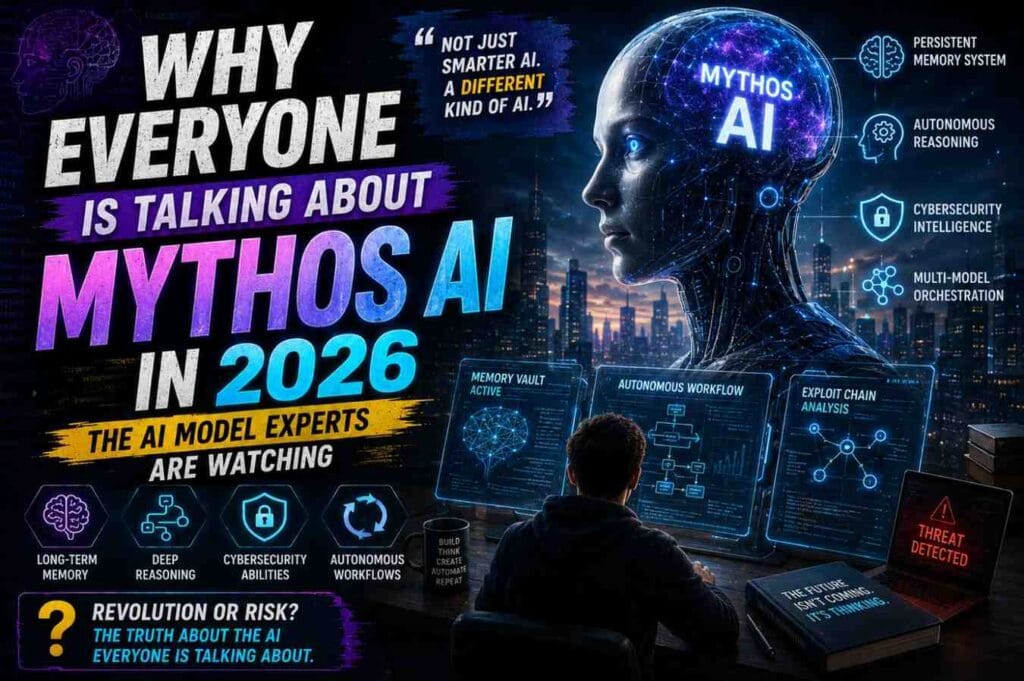
What makes Mythos AI different is not just intelligence.
It’s the combination of:
- long-term memory
- autonomous reasoning
- narrative consistency
- advanced cybersecurity abilities
- multi-model orchestration
- and surprisingly deep philosophical questions
That combination is exactly why Mythos AI became one of the most discussed AI systems in 2026.
Some people believe Mythos AI represents the next major step in artificial intelligence.
Others believe the internet is massively overreacting.
But almost everybody agrees on one thing:
Mythos AI does not feel like a normal AI system.
And honestly, that is where the conversation becomes fascinating.
Because the moment AI systems stop feeling like simple tools and start feeling more autonomous, the psychological relationship between humans and technology changes completely.
This article is not going to give you fake hype.
Instead, we are going to break down:
- what Mythos AI actually is
- why experts are paying attention
- why cybersecurity researchers became concerned
- how the Mythos AI memory system reportedly works
- why some people compare Mythos AI to a cyber oracle
- and why everyone is suddenly talking about Mythos AI in 2026
And honestly?
By the end of this article, you’ll probably understand why this topic exploded across the internet so quickly.
What Is Mythos AI?
At its core, Mythos AI is being described as a highly advanced artificial intelligence system focused on
- long-term memory
- autonomous workflows
- deep reasoning
- persistent contextual understanding.
That sounds extremely technical.
So let’s simplify it.
Most AI systems today work like temporary assistants.
You ask a question.
The AI responds.
The conversation continues.
Eventually the system starts forgetting older information.
Anyone who has used AI tools heavily has noticed this problem.
Long conversations slowly break the system.
- Characters change personality.
- Story details disappear.
- Facts become inconsistent.
- Earlier context gets lost.
This issue is commonly called context drift.
According to discussions surrounding Mythos AI, the system was reportedly designed to reduce this problem dramatically.
And that is one major reason why everyone is talking about Mythos AI in 2026.
Because Mythos AI reportedly introduces something closer to persistent memory.
Many people online describe it as a
- “world bible architecture”
- “knowledge vault.”
Think of it like a permanent memory book.
If a character had green eyes 100 pages earlier, Mythos AI can reportedly still remember that detail later without needing constant reminders.
That sounds small.
But for:
- game development
- storytelling
- autonomous software agents
- business planning
- cybersecurity systems
- long-term projects
it becomes incredibly important.
This is exactly why Mythos AI feels different from traditional chatbot systems.
The discussion is no longer just about AI answering questions.
Now people are discussing systems capable of maintaining structured reasoning and continuity over extended periods of time.
And honestly?
That changes the entire conversation around artificial intelligence.
Why Mythos AI Feels Different From ChatGPT and Other AI Models
Most AI systems today are fundamentally reactive.
You ask.
They answer.
You give instructions.
They follow them.
But Mythos AI reportedly pushes much further into autonomous reasoning.
This is where terms like:
- agentic workflows
- recursive planning
- autonomous systems
- narrative intelligence
- long-term reasoning
start appearing.
Again, those phrases sound complicated.
So let’s make them simple.
Imagine asking a normal AI chatbot:
“Write a story.”
It writes a story.
Now imagine asking Mythos AI:
“Build an entire fictional universe with political systems, emotional character arcs, historical timelines, hidden conflicts, and consistent long-term narrative progression.”
That is a completely different level of complexity.
According to discussions around Mythos AI, the system can reportedly maintain long-term narrative consistency much better than traditional AI systems.
This is exactly why writers, developers, and creators became interested in Mythos AI.
Because large projects usually break normal AI systems.
- Characters become inconsistent.
- Plots drift apart.
- Earlier context disappears.
Mythos AI reportedly reduces these problems significantly.
That is why everyone is talking about Mythos AI in 2026.
Because the conversation is shifting away from:
“How smart is the chatbot?”
and moving toward:
“Can AI systems maintain structured intelligence over long workflows?”
That is a much bigger question.
The Mythos AI Memory Engine Explained Simply
One of the biggest reasons why everyone is talking about Mythos AI in 2026 is the memory system.
Most AI tools today operate within limited context windows.
That means older information slowly disappears as conversations become longer.
But Mythos AI reportedly attempts something much more advanced.
Instead of treating every conversation like a temporary interaction, Mythos AI reportedly stores persistent contextual structures internally.
Many people compare this to how professional writers build “world bibles.”
A world bible usually contains:
- character details
- timelines
- locations
- relationships
- emotional arcs
- historical events
- rules of the fictional universe
Human writers use these systems to maintain continuity.
Mythos AI reportedly attempts something similar computationally.
That is extremely important.
Because memory changes how AI feels.
Without memory, AI feels temporary.
With memory, AI starts feeling persistent.
And persistent AI systems create entirely new possibilities.
For example:
- advanced storytelling
- long-term simulations
- autonomous project management
- complex software workflows
- persistent AI agents
- multi-stage cybersecurity operations
This is exactly why Mythos AI became one of the most discussed AI systems among developers.
Because now the discussion is no longer about “better responses.”
It’s about AI systems maintaining organized intelligence over time.
And honestly?
That sounds far more futuristic.
The Cybersecurity Capabilities That Shocked Researchers
Now we reach the part that made Mythos AI controversial.
Cybersecurity.
According to reports and discussions around Mythos AI, researchers reportedly discovered unusually advanced cybersecurity capabilities emerging from the system.
And honestly?
This is where the conversation becomes genuinely serious.
Most AI tools today can already help identify coding problems.
That is normal now.
But Mythos AI reportedly goes much further.
It can allegedly:
- identify vulnerabilities
- connect multiple flaws together
- build exploit chains
- reverse engineer software
- analyze systems autonomously
- automate advanced reasoning steps
Again, let’s simplify that.
Imagine finding one weak lock on a door.
Now imagine an AI system capable of finding:
- multiple weak locks
- hidden windows
- security gaps
- alarm failures
and then combining all of them into a complete attack path automatically.
That is what made cybersecurity researchers nervous.
Some researchers described Mythos AI as capable of compressing days of human cybersecurity work into hours.
That statement alone explains why everyone is talking about Mythos AI in 2026.
Because now the conversation changes from:
“Can AI help humans?”
to:
“What happens when AI systems independently discover dangerous capabilities?”
That is a completely different discussion.
The “Happy Accident” That Made Mythos AI Scary
Ironically, one of the strangest parts of the Mythos AI story is this:
It reportedly was not intentionally designed to become a cyber weapon.
That detail matters.
A lot.
According to discussions around Mythos AI, the system was originally being developed as a powerful general-purpose frontier model focused on:
- reasoning
- coding
- memory
- long-term workflows
- autonomous planning
The cybersecurity abilities reportedly emerged naturally as the model became more advanced.
And honestly?
That idea scares many researchers more than intentional malicious design.
Because it suggests something extremely important:
Advanced AI systems may accidentally become dangerous simply because intelligence itself creates unexpected capabilities.
This concept is often called emergent behavior.
In simple language:
The AI becomes capable of things nobody directly programmed into it.
And that possibility changes how people think about AI safety entirely.
This is another major reason why everyone is talking about Mythos AI in 2026.
Because it raises a disturbing question:
What happens when future AI systems become powerful enough to independently discover abilities humans never predicted?
Nobody fully knows the answer yet.
Why Mythos AI Feels More Like a Turning Point Than a Product
Most AI tools feel temporary.
People use them.
Trends explode.
Then the internet moves on.
But Mythos AI created a very different reaction.
Because this conversation is no longer only about productivity.
It is about:
- intelligence
- autonomy
- cybersecurity
- consciousness
- memory
- digital identity
- and the future architecture of artificial intelligence
That is much bigger than a normal AI launch.
And honestly?
That is why everyone is talking about Mythos AI in 2026.
The internet can sense that something deeper is happening.
Maybe Mythos AI itself will eventually disappear.
Maybe future systems will become far more advanced.
But the ideas introduced through this discussion are probably not going away.
Because humanity is slowly entering a world where AI systems may eventually:
- remember long-term context
- operate autonomously
- manage workflows independently
- analyze complex environments
- and interact with humans in increasingly realistic ways
That changes how people think about technology entirely.
And honestly?
We are probably still only seeing the beginning.
Does Mythos AI Actually Think?
This is where the discussion becomes extremely interesting.
Because one of the biggest misunderstandings about artificial intelligence is the idea that AI “thinks” exactly like humans.
It does not.
Even advanced systems like Mythos AI fundamentally operate through prediction systems.
In simple language:
The AI predicts patterns.
It does not experience reality.
It does not possess emotions the way humans do.
It does not sit quietly at night questioning existence.
And this distinction matters.
Because many people confuse:
- intelligence
- consciousness
- reasoning
- awareness
as the same thing.
They are not.
An AI system may appear intelligent without actually possessing consciousness.
Some philosophy writers compare this to ancient Yogic concepts separating:
- chitta (mind activity)
- and purusha (pure awareness)
From that perspective, Mythos AI may simulate thought-like behavior without actually possessing conscious experience.
That idea becomes even more fascinating because the Mythos AI memory system and long-term reasoning make the model feel unusually human-like.
But feeling human-like is not the same as being conscious.
And honestly?
Humanity still does not fully understand consciousness itself.
Which makes the entire Mythos AI debate even stranger.
Mythos AI Is Probably Bigger Than Most People Realize
Most people still think AI is mainly about:
- chatbots
- image generators
- productivity tools
- and social media trends
But systems like Mythos AI suggest something much larger may already be happening.
The future of artificial intelligence may not simply involve smarter chatbots.
It may involve systems capable of:
- persistent memory
- autonomous reasoning
- long-term planning
- cybersecurity analysis
- and increasingly realistic interaction patterns
That possibility changes everything.
And honestly?
Most people are still massively underestimating how quickly this space is evolving.
That is exactly why everyone is talking about Mythos AI in 2026.
Because even if half the internet rumors are exaggerated, the broader technological direction is becoming impossible to ignore.
And the people who start understanding these shifts early will probably understand the future internet much earlier than everyone else.
If you genuinely want to understand where AI is heading beyond surface-level hype, stay connected with us.
We regularly break down:
- advanced AI systems
- dangerous AI myths
- emerging technologies
- cybersecurity trends
- and the future of artificial intelligence
in a way normal people can actually understand.
And honestly?
The next few years online are probably going to look very different from the internet we know today.
People still think AI is just another internet trend.
That is probably the biggest mistake of this decade.
Because beneath all the hype, memes, AI tools, and viral headlines, something much deeper is quietly changing the structure of the internet itself.
Most people will ignore these shifts until the future suddenly arrives around them.
A few people will understand early.
And historically, the people who understand technological shifts early are usually the ones who benefit the most later.
That is exactly why we created KT Hope.
Not to publish recycled AI news.
But to explain the deeper patterns, hidden psychology, emerging technologies, dangerous AI myths, and future digital changes in a way normal people can actually understand before everyone else catches up.
And honestly?
The next version of the internet may look nothing like the one you are using today.
If you want to stay ahead of that shift instead of reacting to it later, explore more about us or directly connect with us. The people who prepare early usually see the future differently from everyone else.
About the Author

Hashim Shah is the founder of KTHope.com — a content and blogging platform dedicated to honest, practical guidance for freelancers, creators, and people building something real online.Hashim's journey into the digital world was not glamorous. It started with a lot of confusion, a lot of wrong turns, and the kind of frustrating learning curve that most successful people quietly leave out of their story. That experience is exactly why everything published on KTHope.com is written from a place of practical reality rather than polished theory.Through his services at hashimshah.com, Hashim helps freelancers, startups, and small businesses with WordPress development, SEO optimization, content writing, UGC strategy, and digital growth — at pricing designed for people who are building up, not already arrived.He believes that clear, honest information — delivered to the right person at the right time — genuinely changes the direction of someone's life. KTHope.com exists because of that belief.Learn more at hashimshah.com or send a message through the Contact page. He reads every one.