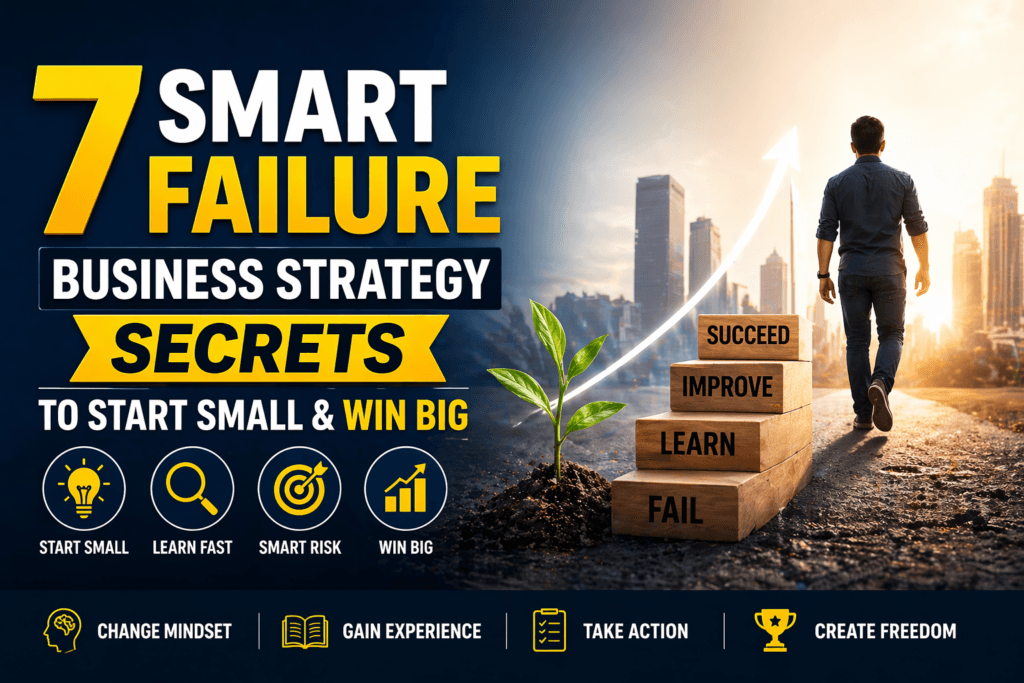
7 Smart Failure Business Strategy Lessons to Start a Low-Risk Business
smart failure business strategy: Starting a business sounds exciting, but in reality, most people never begin. Not because they lack ideas, but because they fear failure.
You might have already thought about ideas like trading clothes, selling dry fruits, or buying products at a lower price and selling them at a higher margin. On paper, it looks simple.
But one question stops everything:
“Where will I sell?”
This is where most beginners get stuck—and eventually give up.
The truth is, business success doesn’t come from perfect planning. It comes from applying a Smart Failure Business Strategy, where you start small, test quickly, and learn faster
Why Most Beginners Fail Before They Even Start
Most people focus only on profit.
They think:
If a product costs $4 and sells for $10, profit is guaranteed
If margins are high, success is easy
But they ignore:
Real market demand
Customer behavior
Risk management
As a result, they either overthink or take a blind step—and both lead to failure.
What is Smart Failure Business Strategy?
Instead of chasing success directly, you should learn how to fail smartly.
Smart Failure Means:
Limiting your risk
Testing ideas in small steps
Learning from every attempt
For example:
If you have $1,200 to invest, don’t put everything into one idea.
Break it down:
$240 × 5 different ideas
Now:
- If one fails → no major loss
- If one works → you scale it
This approach is the foundation of a Smart Failure Business Strategy.
Start Small, But Start With Clarity
Step 1: Focus on One Category
One of the biggest mistakes beginners make is trying everything at once.
- Clothes
- Dry fruits
- Accessories
- Random trending products
This creates confusion.
Instead, choose one category.
For example: Baby products
Why?
- Consistent demand
- Emotion-driven purchases
- Works in every location
Step 2: Find Product-Market Fit
Before investing money, understand what the market actually needs.
Ask simple questions:
- What products are selling the most?
- Which items do shopkeepers always reorder?
You can:
- Talk to local retailers
- Visit wholesale markets
- Analyze online platforms
- Use AI tools for insights
Your goal is to identify 8–10 products with consistent demand.
Step 3: Source at the Lowest Possible Cost
Once you know what sells, the next step is sourcing.
- Compare multiple suppliers
- Negotiate pricing
- Look for direct manufacturers
The goal is simple: Buy lower than your competitors’ purchase price
Step 4: Start Selling Smartly
In the beginning:
- Focus on cash transactions
- Avoid giving credit
As you build relationships:
- Slowly introduce credit
- Work only with trusted buyers
The Difference Between Confidence and Overconfidence
Many beginners say,
“I am confident I can do this.”
But real confidence is not based on belief—it is based on experience.
Overconfidence comes from assumptions.
Real confidence comes from testing.
Business is Not About Luck—It’s About Calculated Risk
Starting a business without experience is very similar to gambling.
The difference is:
- In gambling, you know the risk
- In business, most beginners ignore it
That’s why a Smart Failure Business Strategy is important.
You treat business like a series of controlled experiments—not a one-time bet.
The Real Power of Smart Failure
Here’s the mindset shift:
❌ Don’t work only to succeed
✅ Work in a way that even failure benefits you
Because:
- If you fail → you gain experience
- If you succeed → you gain growth
Either way, you move forward.
Understanding Money the Right Way
Many people grow up believing:
- Money is bad
- Rich people are greedy
But in reality:
Money represents freedom.
Just like fuel powers a car, money powers your choices.
Without money:
- Your options are limited
With money:
- You decide how to live
The 3 Levels of Financial Life
1. Survival (Job-Based Income)
You exchange time for money.
If you stop working, income stops.
2. Security (Stable Income)
You have some stability, but still depend on a system.
3. Freedom (Business or Assets)
Money works for you—even when you don’t work.
This is where true independence begins.
Smart Failure vs Bad Failure
Bad Failure:
- Large investment
- No learning
- No second chance
Smart Failure:
- Small controlled loss
- Valuable learning
- Strong comeback
Final Lesson: Fail Fast, Learn Faster
You don’t need:
- A perfect idea
- A large budget
- Complete knowledge
You need:
- Action
- Testing
- Smart risk-taking
Because in the long run:
You either succeed, or you become skilled enough to succeed next time.
Conclusion
- Start small.
- Think clearly.
- Take controlled risks.
Follow the Smart Failure Business Strategy, and you won’t just chase success—you will build it step by step.
👉 For more practical strategies, visit
If you found this article helpful, don’t stop here.
👉 Read my previous article here
It will give you deeper clarity and practical insights to take your next step.
📩 Want to connect or work with me?
Reach out here
Also, if you want to explore more real-world business insights and market trends, I highly recommend checking out Forbes for valuable updates and expert perspectives.
About the Author

Hashim Shah is the founder of KT Hope —
an AI tools expert, content writer, and digital marketer. He shares practical, research-driven content on AI tools, SEO, blogging, and online business growth to help readers work smarter and succeed online.